Billbooks’ free hourly rate calculator gives freelancers two numbers instead of one guess: a market rate range built from real U.S. government wage data, and a break-even rate based on your own income goal and expenses. Enter your profession, location, and experience level, and see both numbers in seconds. No signup required.
Two Numbers Beat One Guess
Pricing your own time is hard because there is no boss handing you a salary band and no HR department benchmarking your role against the market. Left alone, most freelancers default to one of two habits: copy whatever a friend charges, or guess low and hope nobody notices. The What Should I Charge? calculator replaces both habits with two real reference points. The market range shows what your profession typically pays in your state, pulled from U.S. government wage data. The break-even rate shows the floor you personally need to charge to hit your income goal once taxes and expenses are accounted for. Read together, they give you a sensible range to price inside, not a single number pulled out of thin air.
How to Use the Calculator
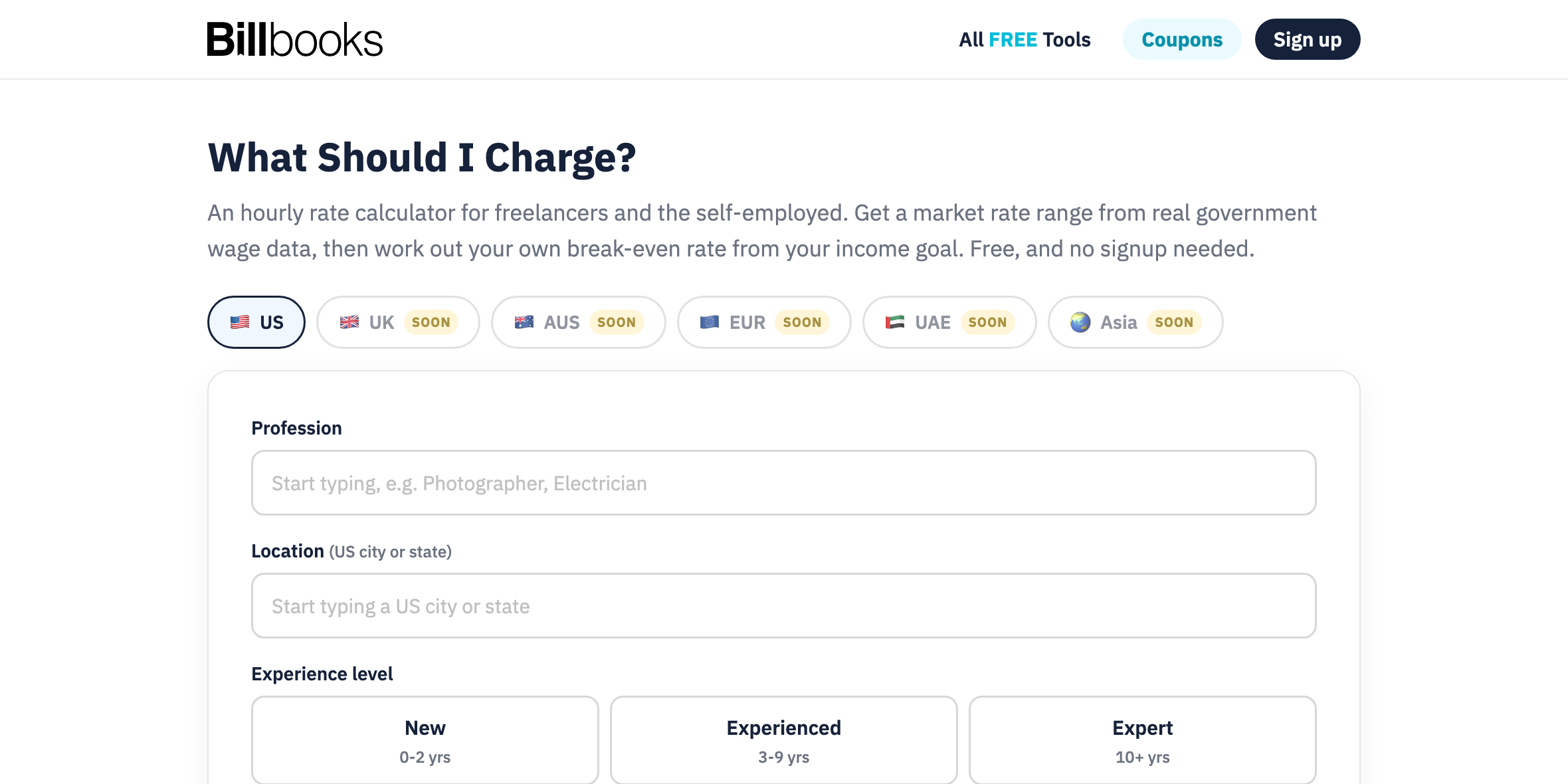
Enter your profession
Start typing a job title, for example Photographer or Graphic Designer, and pick the closest match.
Add your location
Enter a US city or state. City inputs resolve to their state automatically, since that is the level the wage data supports.
Pick your experience level
New covers 0 to 2 years, Experienced covers 3 to 9, and Expert covers 10 or more.
See your rate
Your market range appears immediately. Add your income goal, work style and expenses for a break-even rate too, it is an optional second step.
Where the Market Range Comes From
The market range comes from the U.S. Bureau of Labor Statistics Occupational Employment and Wage Statistics program (OEWS), the government’s own annual survey of wages by occupation and state, most recently updated with May 2025 data. Your experience level maps to a wage percentile inside that survey: new maps to the 25th percentile, experienced to the median, and expert to the 75th through 90th percentile. Every result traces back to that official source, so you can check the number yourself instead of taking our word for it.
How Your Break-Even Rate Is Calculated
The break-even rate is not a survey number, it is your own math worked out for you. Billbooks takes your desired annual income and grosses it up for the 15.3% combined Social Security and Medicare self-employment tax rate set by the IRS, so what is left after tax still matches your goal. It adds your annual business expenses on top, then divides the total by your annual billable hours, your weekly billable hours multiplied by 50 weeks, which builds in roughly two weeks off a year. The starting billable-hours and expense figures come from a Solo or Small team preset, both editable under Adjust assumptions to match your own setup.
A Real Example: Pricing a Freelance Graphic Designer in California
Here is what the two numbers look like side by side. A graphic designer with three to nine years of experience working in California gets a typical market range of $27 to $48 an hour, based on BLS wage data for employees in that occupation and state. If that same designer wants an $80,000 annual income working solo, with 25 billable hours a week and $6,000 a year in expenses as the starting assumptions, their break-even rate comes out to $80 an hour, well above the top of the market range.
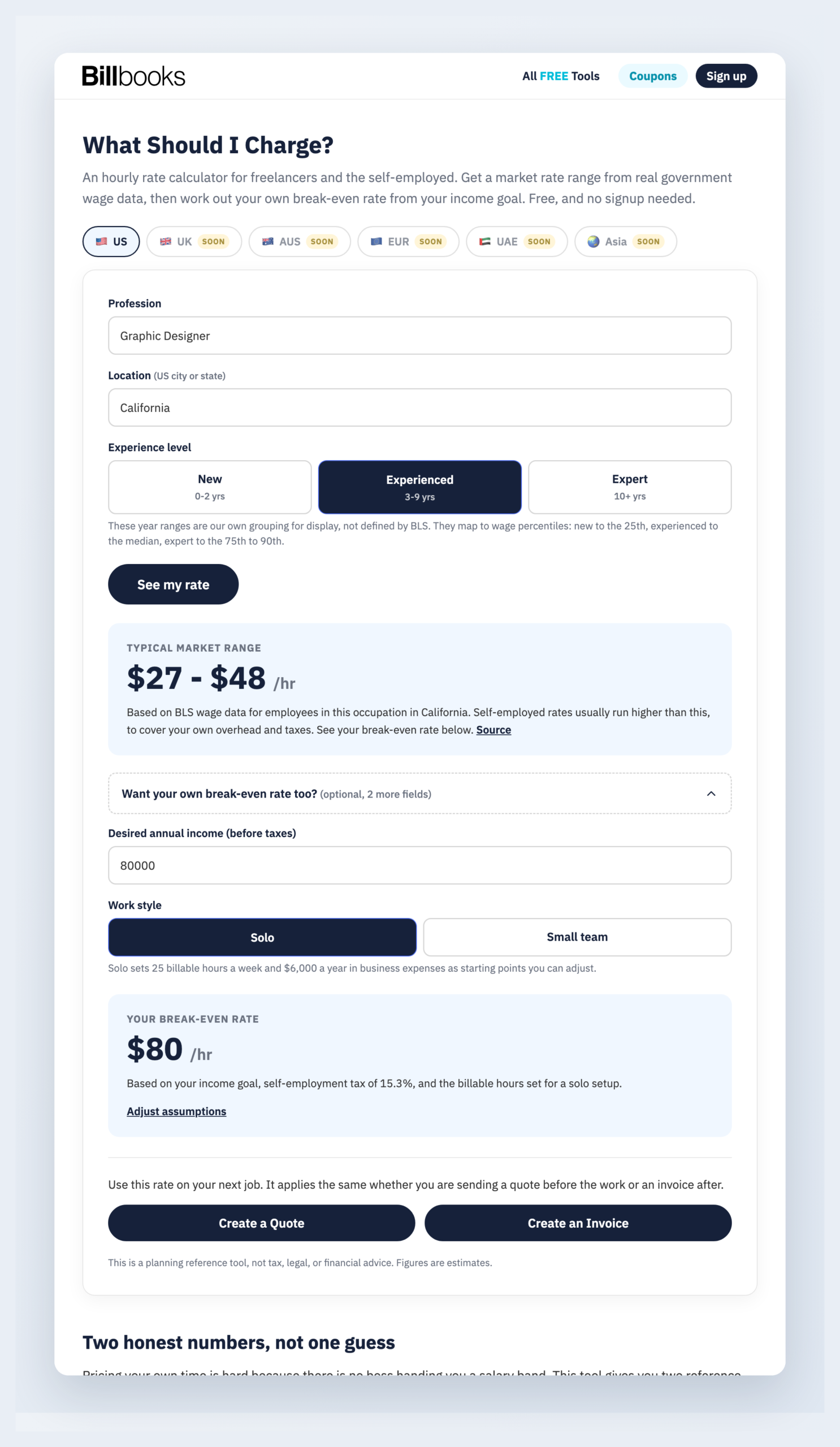
how far above the top of the market range this designer’s break-even rate landed, $80 an hour against a $48 market ceiling
Source: this worked example, calculated from Billbooks’ free hourly rate calculator
That gap is not a bug. It is exactly why the tool shows both numbers: the market range tells you what employees in that field earn, the break-even rate tells you what a self-employed person actually needs to charge to reach the same income after tax and overhead.
Why Your Break-Even Rate Might Be Higher Than the Market
The market range reflects what employees earn, and employees do not pay self-employment tax or cover their own downtime, tools, and overhead out of that wage. Freelancers do, so the break-even rate builds those costs back in. If your break-even sits above the market range, treat it as a signal rather than a problem: raise your prices, look for better-paying clients, or trim your costs, instead of pricing yourself at what an employee earns.
Know your rate? Send it professionally.
Turn your number into a clean quote or invoice in minutes, free to start, no credit card needed.
Turn Your Rate Into a Quote or Invoice
Once you know your number, the next step is sending it professionally. Billbooks’ invoicing and quotes feature lets you turn any rate into a polished quote before the work starts or an invoice once it is done, using the same line items either way, and it is built specifically for how freelancers actually work. If you would rather start from a ready-made layout, our invoice templates cover typical freelance formats you can fill in directly. And if you need to send one right now, the free invoice generator and free quote generator create one immediately, no account required.
Two More Free Tools Worth Pairing With This One
Your hourly rate is one piece of pricing freelance work. The Freelance Budget Calculator helps you plan income and expenses month to month, and the Business Loan Calculator is useful once you are financing equipment or covering a slow season. Both are free, and neither needs a signup.
Built for a Global Rollout
The calculator currently runs on US wage data. The UK, Australia, the Eurozone, the UAE, and a broader Asia region are all marked as coming soon on the tool itself. We are building out real wage data for each region rather than guessing at currency conversions, so pricing stays accurate once those go live.
What to Check Next as a New Freelancer
If you are newer to freelancing, our guides on the essentials every new LLC needs before taking on clients and whether you need a business bank account before your first invoice cover the two setup questions that tend to come up around the same time as pricing. And if your invoicing needs have outgrown a simple generator, see when it makes sense to upgrade from a free invoice generator to full invoicing software.
Price with confidence, then invoice in the same place.
Billbooks plans start at $7.95 a month, with a 30-day free trial and no credit card needed.
Frequently Asked Questions
Is this the same as what I will actually get paid?
Not exactly. The market range is a reference for what the work is worth in your state, based on government wage data for employees. Your actual rate depends on your clients, your niche, and your costs, which is why the break-even rate lets you factor in your own numbers.
Why does the market range use state data and not my city?
The government wage survey is reliable at the state level for most occupations, but city-level figures are often missing or too small a sample to trust. So if you enter a city, we resolve it to its state and show the state rate.
Why is my break-even rate higher than the market range?
Because the market range reflects what employees earn, and employees do not pay self-employment tax or cover their own downtime and overhead out of that wage. As a freelancer you do, so your break-even rate builds those back in. If your break-even sits above the market range, it is a sign to either raise prices, find better-paying clients, or trim costs.
What are billable hours and why multiply by 50?
Billable hours are the hours you can actually charge a client for, which is always fewer than the hours you work, because some time goes to admin, sales, and running the business. We multiply your weekly billable hours by 50 to allow for about two weeks off a year. You can change the weekly number under Adjust assumptions.
Is this tax or financial advice?
No. It is a planning reference tool to help you think about pricing, and the figures are estimates. For decisions about taxes or your specific finances, talk to a qualified professional.
Is it free?
Yes. It is completely free, with no signup and no credit card. Enter your details and see your numbers right away.